All articles
How to Prevent Lice Eggs From Hatching: A Complete Guide for Families
Learn how to prevent lice eggs from hatching, remove stubborn nits, and stop reinfestation. Book professional lice treatment with Zero Lice in Dubai, Sharjah & Ajman.
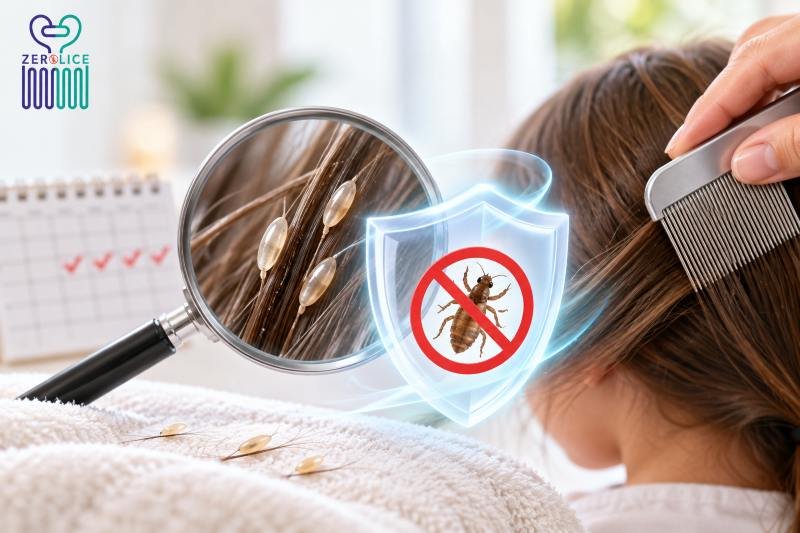
Finding lice eggs attached to your child’s hair can be frustrating, especially when you have already removed the live lice. The biggest concern for many parents is simple: how to prevent lice eggs from hatching and starting the infestation all over again.
Lice eggs, also called nits, are firmly attached to individual hair strands close to the scalp. Because they are harder to remove than crawling lice, simply washing the hair or killing the adult lice may not always solve the entire problem.
The most effective approach focuses on careful inspection, thorough nit removal, repeat checking, and timely follow-up.
If you are dealing with an active infestation, Zero Lice UAE provides professional lice and nit removal with clinic and home-service options for families across Dubai, Sharjah, and Ajman.
How Long Do Lice Eggs Take to Hatch?
Head lice eggs normally hatch within approximately 6 to 9 days when they remain close enough to the scalp to receive the warmth they need.
Once an egg hatches, a tiny immature louse called a nymph emerges. It then develops into an adult louse capable of continuing the infestation.
This is why removing crawling lice alone is not always enough.
Even a small number of viable eggs left behind may hatch several days later, making it appear that the lice have suddenly “come back.”
The key to stopping this cycle is therefore not simply killing live lice. You need to identify and remove attached eggs and continue checking the hair during the days after treatment.
If you are having trouble identifying them, read our guide on how to remove lice eggs from hair.
How to Prevent Lice Eggs From Hatching
There is no single shortcut that guarantees every attached egg will simply stop developing. The practical goal is to remove viable eggs before they hatch and catch any newly hatched lice before they mature and reproduce.
Here are the most important steps.
1. Remove Lice Eggs Carefully From the Hair
Physical nit removal is one of the most important parts of breaking the lice life cycle.
Use a fine-toothed nit comb and divide the hair into small sections. Work slowly from the scalp toward the ends, paying particular attention to:
- Behind the ears
- Around the neckline
- The crown of the head
- Hair close to the scalp
Lice eggs are attached tightly to the hair shaft and usually do not brush away like dandruff.
If you are not sure whether the white particles you see are nits, check our guide to the difference between lice and dandruff.
2. Do Not Rely on Normal Shampoo
Ordinary shampoo may clean the hair, but it is not designed to remove an active lice infestation or detach every nit.
One of the reasons families experience repeated infestations is that the crawling lice disappear temporarily while eggs remain attached to the hair.
Days later, those eggs may hatch.
Instead of repeatedly washing the hair and hoping the eggs disappear, concentrate on thorough inspection and mechanical removal.
3. Comb the Hair Strand by Strand
A quick comb through the hair may miss eggs hidden between thick sections.
Effective nit removal requires patience.
Separate the hair into small sections and inspect each one carefully under good lighting.
After every pass, wipe or rinse the comb so you can see what has been removed.
This is especially important for children with long, thick, curly, or difficult-to-section hair.
Professional treatment may be helpful when home combing becomes too difficult or when repeated attempts have not cleared the infestation.
Zero Lice follows a structured inspect, remove, comb and verify approach. You can see each stage in the Zero Lice treatment process.
Why Can Lice Eggs Still Hatch After Treatment?
Parents sometimes assume that one treatment automatically destroys every egg.
However, eggs can be more difficult to eliminate than crawling lice. Depending on the method used, some may remain attached and viable.
Other common reasons lice appear after treatment include:
- Eggs were missed during combing.
- Treatment did not cover the entire scalp and hair.
- The treatment was stopped too early.
- Another family member still has lice.
- The child was exposed again through close head-to-head contact.
- Follow-up inspection was skipped.
This is why seeing lice again does not always mean they appeared “from nowhere.”
It may be newly hatched lice from eggs that were previously difficult to detect, or it may be a new exposure.
Why Is the Follow-Up Check So Important?
Timing matters when you are trying to interrupt the lice life cycle.
Zero Lice currently includes a 5–7 day follow-up with its listed treatment packages. The purpose is to check for anything that may have hatched after the initial appointment and remove it before it has the opportunity to continue the cycle.
You can review the current options on the Zero Lice pricing and packages page.
Skipping the follow-up because the hair “looks clear” can be risky. Newly hatched lice are much smaller than adults and can be difficult to spot during a quick home inspection.
A carefully timed recheck provides another opportunity to examine the scalp and hair thoroughly.
Should the Whole Family Be Checked?
Yes, close contacts should be checked when one family member has confirmed head lice.
Head lice spread mainly through direct head-to-head contact, which makes transmission particularly common among children and people living in the same household.
That does not mean everyone needs unnecessary treatment.
Instead, inspect each person carefully and take action when live lice or signs of an active infestation are identified.
It is also sensible to avoid sharing personal hair items such as:
- Combs
- Hairbrushes
- Hair ties
- Hats
- Hair accessories
Early detection can prevent one case from becoming a repeated problem throughout the household.
Can You Prevent Lice Eggs From Hatching With Home Remedies?
Be cautious with DIY treatments that promise instant results.
Vinegar, essential oils and other home remedies are frequently recommended online, but families should not assume that a home mixture will reliably destroy every lice egg.
Repeatedly experimenting with different substances can also irritate the scalp without solving the underlying infestation.
The more dependable strategy is to identify the infestation correctly, remove lice and attached nits carefully, and perform follow-up checks.
If repeated home attempts are not working, professional lice removal can save families from continuing the same treatment cycle.
When Should You Consider Professional Lice Removal?
Consider professional help if:
- You continue finding live lice after home treatment.
- Eggs remain attached despite repeated combing.
- The infestation keeps returning.
- Several members of the family may be affected.
- The hair is very thick, long or difficult to inspect.
- You are unsure whether you are seeing lice eggs or dandruff.
- You want a thorough professional screening.
Zero Lice provides lice screening and removal for children, adults and families, with options available across Dubai · Sharjah · Ajman.
Stop the Egg-to-Lice Cycle Before It Starts Again
Waiting for eggs to hatch makes the problem harder to control.
A thorough inspection today can help identify live lice and attached nits before the infestation develops further.
Book professional lice and nit removal with Zero Lice UAE.
Choose a clinic appointment or ask about an at-home visit in Dubai, Sharjah or Ajman.
FAQs About Preventing Lice Eggs From Hatching
Can lice eggs hatch after treatment?
Yes. Some eggs may remain viable after certain treatments or may have been too difficult to detect during the first inspection. This is why careful nit removal and follow-up checks are important.
How long does it take for lice eggs to hatch?
Lice eggs commonly hatch in around 6 to 9 days when they remain in suitable conditions close to the scalp.
Does washing hair remove lice eggs?
Normal hair washing usually does not remove all nits because they are firmly attached to individual hair strands.
Should I remove every nit from the hair?
Careful removal of attached nits can help reduce the chance of viable eggs remaining in the hair. It also makes follow-up inspection easier.