All articles
Why Lice Treatment Often Fails at Home and How to Avoid Common Mistakes
Lice is one of the most annoying problems that many families face, especially children in school age. Although there are many home treatments available for head lice, a large number of cases are not fully cured and the infestation returns within days or weeks.
Lice is one of the most annoying problems that many families face, especially children in school age. Although there are many home treatments available for head lice, a large number of cases are not fully cured and the infestation returns within days or weeks.
In most situations, the issue is not the difficulty of killing lice itself, but rather common mistakes during treatment that allow the infestation to continue or spread within the household. In this article, we explain the real reasons why home lice treatment fails and the correct methods to avoid these errors.
Why Does Home Lice Treatment Often Fail?
Lice treatment does not only depend on killing visible insects in the hair. It requires eliminating both lice and eggs, as well as preventing reinfestation.
Many families stop at one step only, such as using a medicated shampoo or a home remedy, without completing the full treatment process. This leads to the problem returning again.
Using Unsafe or Inappropriate Substances on the Scalp
One of the most common reasons for treatment failure is using substances that are not designed for hair or skin use.
Harmful substances instead of treatment
Some people use strong chemicals such as kerosene or harsh cleaning products, believing they kill lice quickly. However, these substances can cause skin irritation or scalp burns, especially in children.
In some cases, household insecticides are also used, which are not intended for human use and are therefore dangerous and unsafe.
Relying on Unproven Home Remedies
Many traditional recipes are widely shared for treating lice, but they do not provide a complete solution.
Oils and natural substances
Olive oil, coconut oil, or essential oils may temporarily reduce lice movement, but they do not kill the eggs attached to the hair, which is the main reason for reinfestation.
Vinegar and household solutions
Vinegar is sometimes used to loosen nits, but it does not kill lice or prevent eggs from hatching, so it cannot be considered a complete treatment.
The mayonnaise myth
Some believe that covering the hair with mayonnaise suffocates lice. This is not scientifically accurate, as lice can survive without oxygen for a period, and eggs remain unaffected.
Ignoring the Step of Removing Lice Eggs
One of the most common reasons for treatment failure is focusing only on adult lice while ignoring the eggs.
Lice eggs are strongly attached to the hair shaft and cannot be removed by washing or simple home remedies. They require careful and repeated combing with proper tools.
If eggs are not fully removed, they will hatch within a few days and restart the infestation.
Not Using the Right Combing Tools
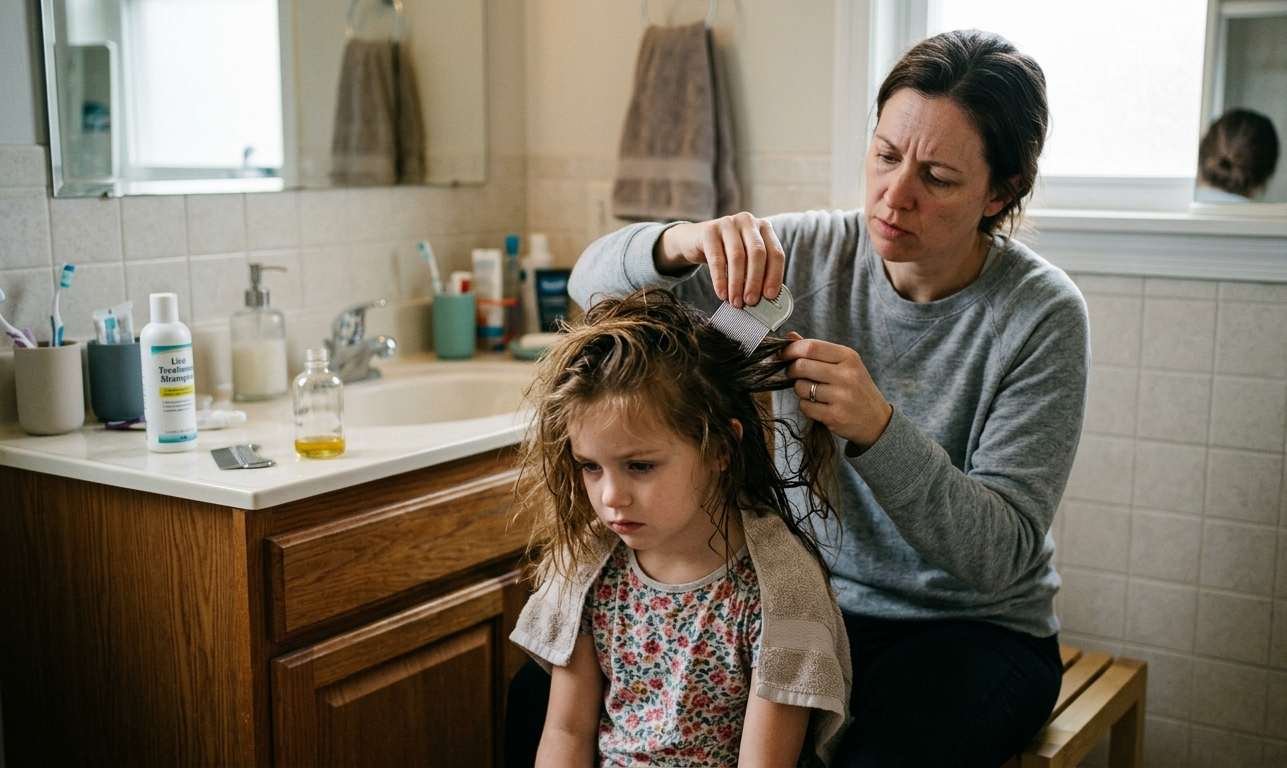
Using a regular comb during treatment is a common mistake.
A standard comb cannot remove lice or tiny eggs effectively, while a fine metal lice comb helps pull out nits more efficiently.
Dividing the hair into small sections during combing also greatly improves treatment effectiveness.
Stopping Treatment Too Early
Another common mistake is stopping treatment as soon as itching disappears or no lice are visible.
In many cases, eggs remain in the hair unnoticed and hatch later, causing the infestation to return.
Lack of Follow Up After Treatment
Successful lice treatment does not end in one day. It requires careful follow up in the following days.
Importance of rechecking
Rechecking helps detect any remaining eggs before they hatch and restart the infestation.
It is recommended to monitor the hair during the first week after treatment.
Treating Only One Family Member
When lice are found in one child, some families treat only that child and ignore others.
However, lice spread easily through direct contact or shared personal items, so more than one family member may be affected without obvious symptoms.
Checking all family members is essential to prevent reinfestation.
Poor Handling of the Surrounding Environment
Although lice do not live long outside the scalp, some behaviors can help the problem persist.
Sharing combs, using the same pillows, or not cleaning personal items during infection can contribute to reinfestation.
Excessive Anxiety and Overreaction
Many families become overly worried when lice appear, leading to unnecessary actions such as excessive cleaning or repeated use of strong chemicals.
In reality, lice treatment requires simple but precise steps rather than extreme measures.
Signs That Lice Treatment Has Failed
Some indicators show that treatment was not fully successful, such as:
- Continued presence of lice in the hair
- New eggs close to the scalp
- Return of itching after a short time
- Multiple family members infected
- Recurrent infestation immediately after treatment
Correct Steps for Successful Home Lice Treatment
To effectively eliminate lice, the following steps should be followed:
- Use approved and safe lice treatment products
- Comb the hair daily with a special lice comb
- Focus on complete removal of eggs
- Recheck the hair in the first days after treatment
- Check all family members
- Wash personal items used during infection
When Should You Visit a Lice Treatment Specialist?
In some cases, home methods may not be effective, especially with thick hair or repeated reinfestation. In such situations, visiting a specialist center can be the best option, as professional tools and techniques help remove lice and nits completely and safely.
Conclusion
Home lice treatment failure is not usually due to the severity of the case, but rather simple repeated mistakes. The most common errors include using unsafe substances, relying on ineffective remedies, ignoring egg removal, and failing to follow up after treatment.
Following a structured and correct process helps eliminate lice permanently and prevents them from returning, while keeping the scalp healthy and protecting children.
Frequently Asked Questions About Home Lice Treatment Failure
Can lice treatment fail even with medicated shampoo?
Yes, it can fail if not used correctly, not repeated at the right time, or if lice eggs are not removed.
Why does lice come back after treatment?
This usually happens because eggs remain in the hair or because reinfection occurs from an infected person at home or school.
Are natural oils enough to treat lice?
Natural oils may reduce lice movement, but they do not eliminate eggs, so they are not a complete treatment.
How often should hair be combed during treatment?
Daily combing with a lice comb is recommended during treatment to ensure effective removal of lice and eggs.
Does vinegar kill lice permanently?
No, vinegar does not kill lice. It may only help loosen eggs for easier removal during combing.
Should all family members be treated?
Yes, because lice spreads easily among household members, even if symptoms are not visible.
Can lice survive outside the hair for long?
No, lice usually die within 24 to 48 hours without feeding.
What is the main reason for treatment failure?
The main reason is not removing lice eggs completely or stopping treatment too early.
Does itching always mean lice is still present?
Not always. Itching may continue for a while after treatment due to scalp irritation, so checking is still necessary.